By Madison Shaw
Originally published in The Bold CU on March 10, 2026.
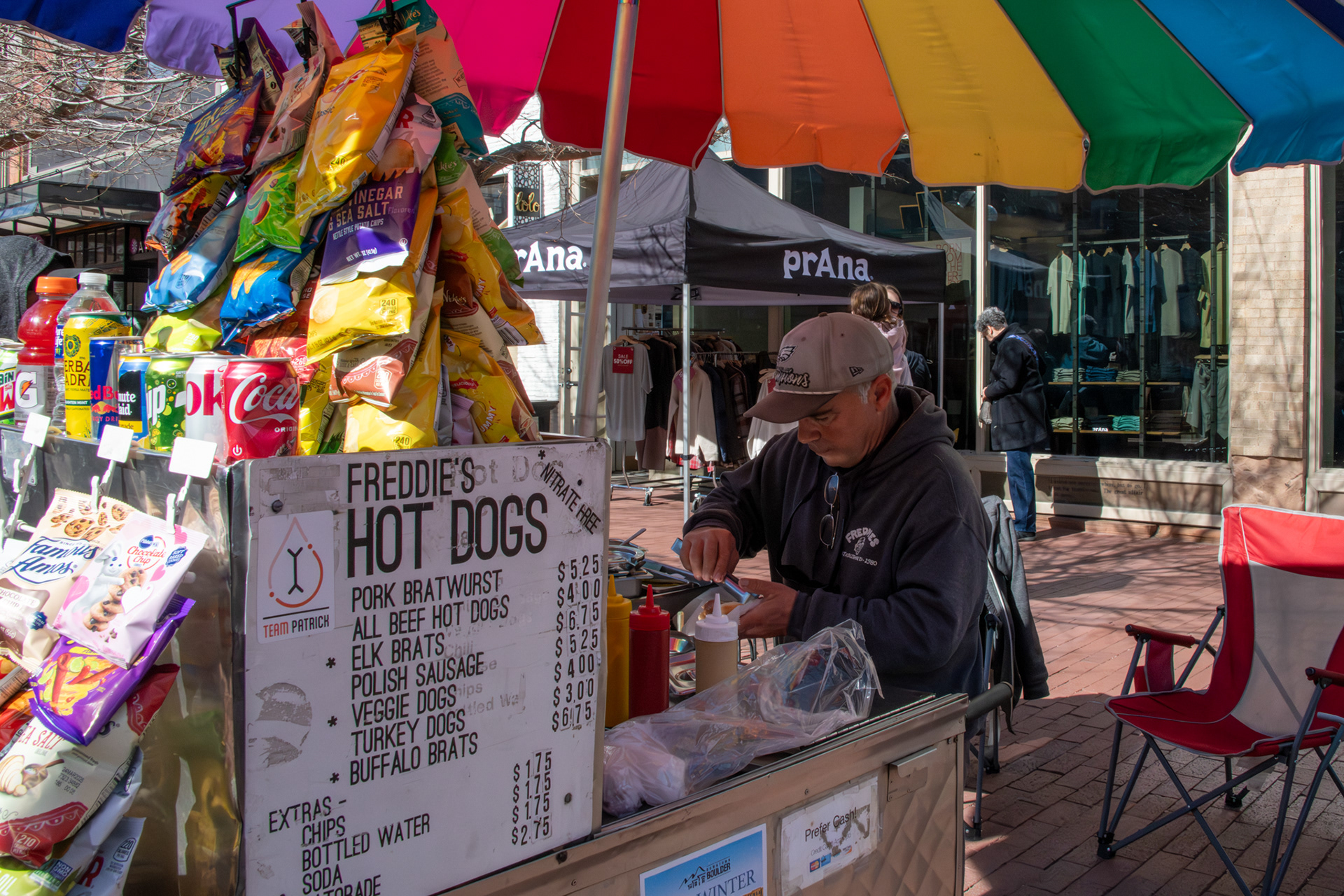
Mike Horowitz prepares a hot dog at Freddie’s Hot Dog Stand on Pearl Street on Feb. 16. (Madison Shaw/The Bold)
By noon, Pearl Street fills with foot traffic and sunlight. Tourists drift between storefronts. Office workers scan lunch options. A busker tunes a guitar down the block.
On the corner of Pearl and Broadway, Mike Horowitz stands beneath the rainbow umbrella of his hot dog cart. He sees a family of four before they reach him.
“How’s your day going?” he asks, smiling.
He moves quickly but never rushes. Bun. Vienna beef hot dog. Mustard. Hand it over. The line keeps moving, but each interaction feels personal.
A woman walks by with her dog and waves.
“That’s Princess,” Mike says, referring to the dog. He keeps working.
For 29 years, he has stood on this corner behind Freddie’s Hot Dog Stand. He bought it sight unseen after answering a newspaper advertisement.
The stand officially opened in 1980. Freddie Snalam, a well-known climber who split his year between running the cart and climbing around the world, owned it for 17 years.
Horowitz grew up in New Jersey. He worked as a blackjack dealer there before he ever thought about Boulder. He visited Colorado once, liked the pace of it, and decided to move west.
In Boulder, he drove a tow truck for a stretch. He did not have much of a plan. Then he saw an ad in the newspaper. A hot dog cart for sale on Pearl Street.
He called Snalam. They agreed on a price over the phone.
“I never even met him or saw the cart or anything,” he says.
Horowitz never expected to surpass Snalam’s tenure.
“Did I think it was going to be long-term? No,” he says.
Pearl Street has changed since then. More national stores have replaced mom-and-pop shops. The economy shifted. The crowd shifted with it. But the hot dog stand stayed.
“The hardest part is pushing it,” Horowitz says. “It’s very heavy. You’re going uphill when it’s completely full.”
He starts prepping at 8:30 a.m., cutting toppings, refilling supplies, wiping everything down before rolling out at 11. Even after closing at 6 p.m., it takes another half hour to break everything down.
He rarely misses a day.
“Maybe when I go to Vegas,” he says. “Or if the weather’s really bad.”
Otherwise, he shows up. He remembers orders faster than names. Mustard only. Chili cheese. Extra onions. He notices when someone looks tired or quiet.
“I like to put a smile on people’s faces,” he says. “Especially if I see that they’re not having a good day.”
Some customers drive by just to see if he is set up. If they spot the rainbow umbrella, they park and walk over.
“It’s nice to know that someone specifically came to the mall for a hot dog,” Horowitz says.
Grace Reilly, a junior in the Leeds School of Business at the University of Colorado, works at Island Farm across from the cart. She became a regular customer about two years ago.
“It was just right there,” Reilly says.
Now she stops in when she forgets to bring lunch.
“Mike's really nice,” she says. “He always asks how I’m doing and about my job.”
Her order is simple. A plain hot dog with ketchup and mustard, and a Dr Pepper.
In a city that constantly reinvents itself, the cart feels steady.
After 11 p.m., the scene shifts. Restaurants close. Pearl Street goes quiet for a moment. Then basement bar doors swing open, and college students spill back onto the red brick stretch. The smell of hot dogs carries down the block. The line builds quickly.
Nick Saltrese, who started working at the cart five months ago, takes over the late shift Thursday through Saturday, a system Horowitz has kept in place for about 15 years.
“It’s all psychology,” Saltrese says. “If you give a drunk person a hot dog, they love you forever.”
Saltrese first met Horowitz in the late 1990s at a basement gym on Pearl Street. Horowitz showed him how to lift weights when he was a teenager at Boulder High School.
“He benched 300 and weighed like 150,” Saltrese says.
Years later, Saltrese asked to work the cart at night. Horowitz agreed.
“Mike locks in with people,” Saltrese says. “People feel seen around him.”
Horowitz tried the late shift once, on a Halloween night years ago, because he did not want to leave a new employee alone.
“It wasn’t as bad as I thought it would be,” he says. “But I wouldn’t want to do that.”
He prefers the steady rhythm of the daytime. The tourists. The regulars. The familiar faces.
In five to seven years, he plans to retire. His shoulders ache from pushing the cart uphill. He is 59. He hopes to sell it. Ideally, it stays in the family. When that day comes, he will miss his regulars.
“I just hope they had good food and a fun experience while getting their food,” he says. “I hope they had fun talking to me.”
Tomorrow at 11 a.m., Horowitz will push the cart back into place.
Bun. Mustard. Smile.
And Pearl Street will keep moving around him.