
TikTok Transforms News Consumption
By Madison Shaw
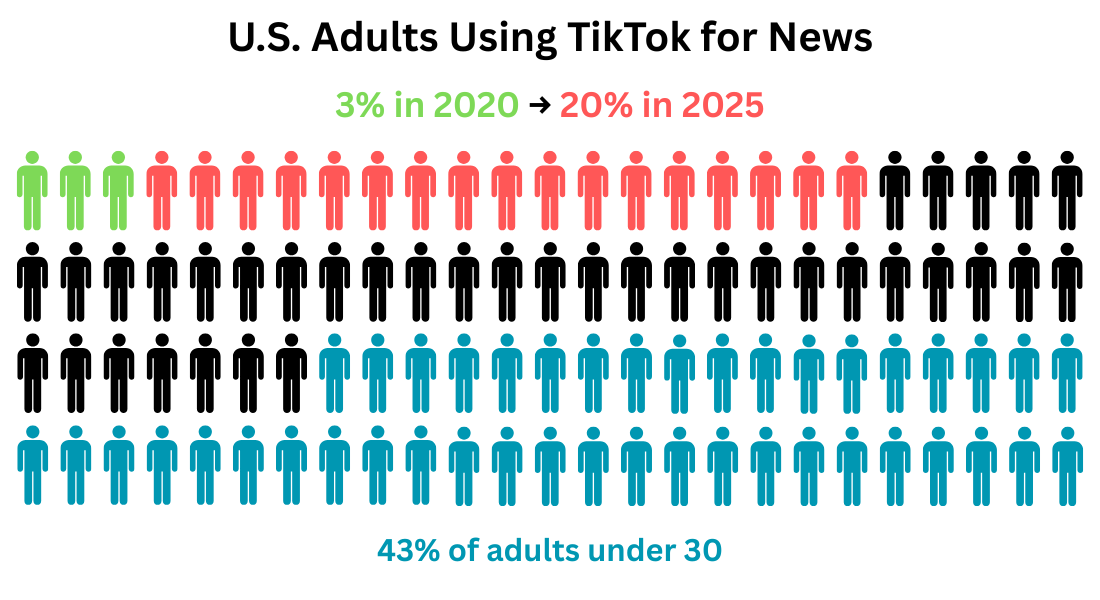
The number of adults in the United States who get their news primarily from TikTok has grown rapidly in the last five years. In 2020, only 3% relied on the app for news. By 2025, the number reached 20%, according to the Pew Research Center. Usage looks even higher among young adults. Pew found that 43% of Americans ages 18 to 29 regularly get news on the platform.
This shift follows a broader change in how young people find information. Pew reports that 76% of adults under 30 get news from social media at least sometimes, while only 60% turn to news websites or apps. Social platforms sit at the center of many young adults’ news routines, and TikTok has grown faster than any other site during the past several years.
The platform does more than pull attention away from newspapers and TV. It reshapes the entire path from information to understanding. The platform delivers short clips, personality-driven commentary, and a constantly shifting feed that reacts to every scroll. Young audiences now learn about the world through quick, tightly edited bursts rather than long articles or full broadcasts. That shift has pushed journalists and educators to rethink how credibility works when news arrives in seconds and often through people rather than institutions.
For many young people, TikTok simply sits in the place where news naturally flows. Pew research shows that 55% of TikTok users regularly encounter news on the platform, even if they never follow a news outlet.
CU Boulder senior Anderson Lhormer fits that pattern. He scrolls throughout the day and often receives updates without searching for them. “I scroll constantly, and I watch the news stories that are on my feed,” he said. His algorithm highlights global conflicts and local events from Georgia, where he grew up.
Lhormer follows several networks. He often trusts content that carries a verification mark. “I choose to trust it blindly, because they have their blue check,” he said. Even with that trust, he considers TikTok less reliable than traditional reporting, but much more convenient.
Other students move through the information landscape with different instincts. Olivia Baker, a junior at New York University, relies heavily on The New York Times. She often reads stories that appear through app notifications or Instagram posts. She prefers the paper’s language choice and steadier tone. “They use language that is not aggressive or extreme,” she said. When something interests her, she checks other outlets and compares perspectives.
Baker rarely uses TikTok for news, although she examined the platform closely during an anthropology project while she was studying abroad this past fall. She searched for videos about Charlie Kirk from Australian sources and perspectives, trying to judge credibility as she scrolled. Verified accounts felt safer than anything else.
One moment changed her view of TikTok. She watched a video that claimed a common item caused cancer. She believed it and repeated it to her mother, who dismissed it immediately. Baker looked up the claim and discovered it was false. “You see their face, and you think you can trust this person,” she said. “They look like they know what they are doing, and then you find out they have no background at all,” she said.
Her experience aligns with Pew’s findings on misinformation. Many Americans feel confident in their ability to recognize inaccurate claims, yet younger adults often struggle to separate factual information from misleading content in algorithmic feeds.
Dr. Angelica Kalika, a journalism instructor at the University of Colorado Boulder, sees potential in TikTok despite its challenges. She believes the platform can strengthen civic understanding when audiences learn how to evaluate what they see and when journalists commit to meeting people in the spaces where news spreads the fastest.
“A lot of people think it is a negative thing that young adults go online for their news,” she said. “However, if you equip young adults with media literacy skills, it is not a problem.”
She hopes young journalists enter these online spaces with intention. She views their presence as essential. “We need educated journalists online, working for themselves or for others, creating quality content that stops disinformation,” she said.